
From start-up to the brand AI recommends first
Sipfull of Design is an Oaklands Creative brand, built from nothing on Shopify. Its domain authority is 6. It's now the brand ChatGPT and Gemini mention most when UK shoppers ask where to buy motoring mugs - and on Google it ranks in the top three for "gardening mugs" and "motoring mugs", with page-one keywords up from 4 to 104 in a year. And it converts at more than twice the Shopify average.
Ubersuggest AI visibility tracking of ChatGPT and Gemini answers to 14 unbranded UK shopping questions, to October 2026.
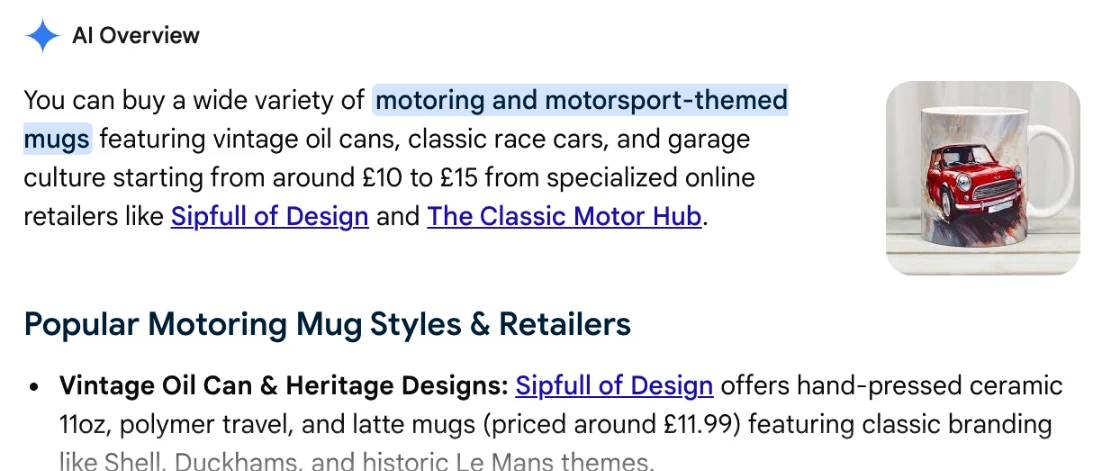
Named first, in Google's own AI answer
Search "motoring mugs" on Google UK and the AI Overview at the top names Sipfull of Design before anyone else, then describes its mugs and prices in detail - pulled straight from the store's own pages.
How ChatGPT and Gemini describe it
"Probably the strongest specialist"
"Probably the widest dedicated motoring selection I found"
Phrases from AI answers to UK shopping questions, recorded by Ubersuggest.
Brand mentions in AI answers
How often each brand was named by ChatGPT and Gemini across 14 shopping questions about motoring and gardening mugs.
| Sipfull of Design | 107 |
|---|---|
| Emma Bridgewater | 56 |
| Etsy UK | 49 |
| Pitstopbits | 32 |
| Norman & Vera | 23 |
By topic
| Topic | Answers mentioning Sipfull |
|---|---|
| Motoring mugs Most-recommended brand in 6 of 7 questions | 73% |
| Gardening mugs Up against Emma Bridgewater, which leads here | 41% |
AI doesn't care how big you are
Google still leans heavily on authority: years of links from other sites. AI assistants work differently. They look for clear, specific, consistent facts they can repeat - what you sell, where it's made, what it costs, how it ships.
Sipfull's pages state those facts plainly, in the copy and in structured data, the same way on every page. So the assistants repeat them. "Hand-pressed to order in Sussex" and "free shipping over £20" turn up in their answers almost word for word.
That's the opportunity for any small retailer right now: you don't need ten years of backlinks to be recommended by AI. You need a store that explains itself properly.
Domain authority 6. Links from 35 sites.
Emma Bridgewater, Etsy and Amazon dwarf Sipfull on authority. In AI answers about motoring mugs, Sipfull is mentioned more than any of them.
Top three on Google, too
Live Google UK results, 7 October 2026: #2 for "gardening mugs", ahead of Emma Bridgewater and John Lewis, and #3 for "motoring mugs". Across the site:
September 2025 compared with September 2026, Google UK. Estimates from Ubersuggest.
Estimated organic visits per month
Sipfull of Design, Google UK, September 2025 to September 2026. The November and December peak is Christmas gifting.
Show the numbers as a table
| Month | Est. organic visits |
|---|---|
| September 2025 | 114 |
| October 2025 | 561 |
| November 2025 | 1,559 |
| December 2025 | 1,405 |
| January 2026 | 803 |
| February 2026 | 731 |
| March 2026 | 838 |
| April 2026 | 545 |
| May 2026 | 457 |
| June 2026 | 507 |
| July 2026 | 477 |
| August 2026 | 626 |
| September 2026 | 1,098 |
The starting point
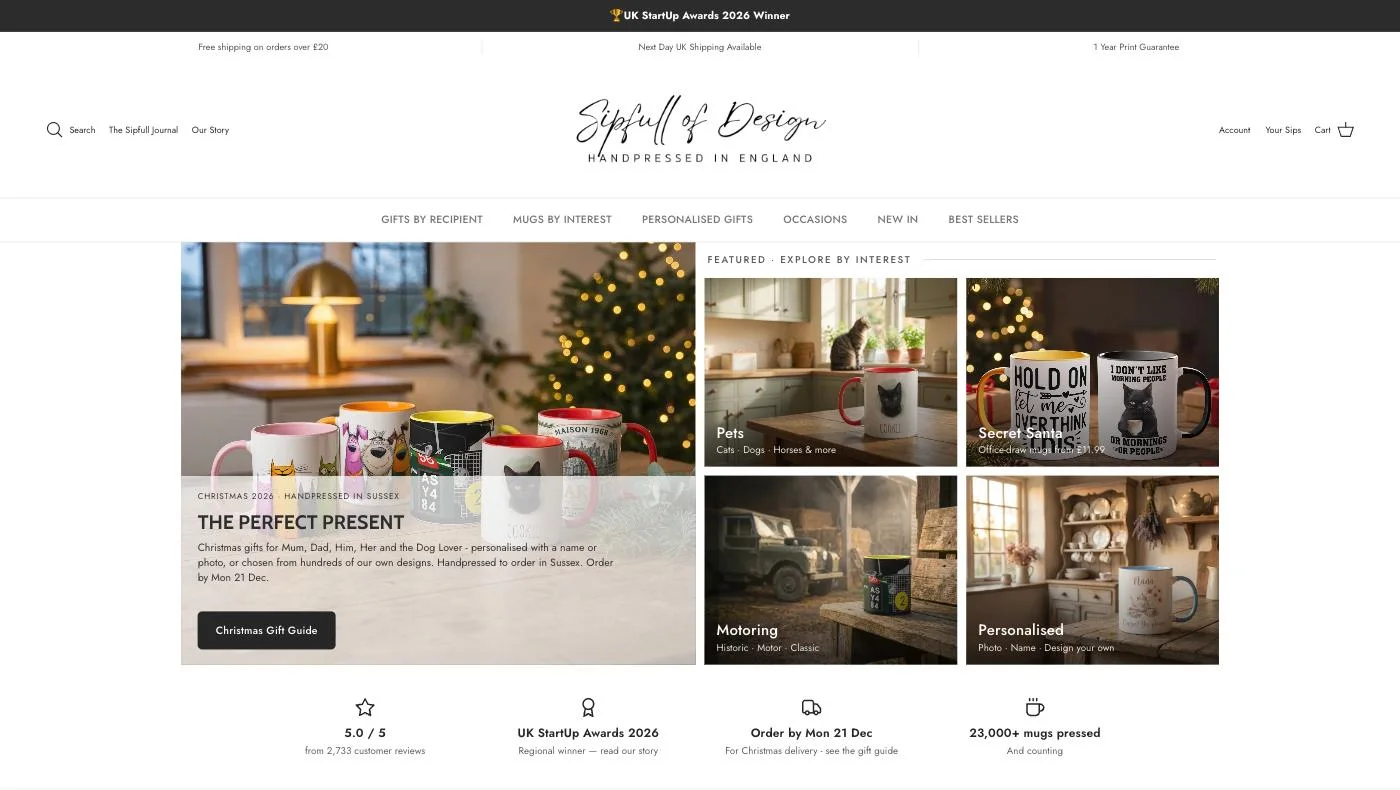
Sipfull of Design sells handpressed and personalised mugs, pressed to order. We launched it as a start-up with no rankings, no backlinks and no brand recognition. It competes for searches like "gardening mugs" and "grandad mug" against big marketplaces with far more authority.
A year ago the site ranked on Google's first page for just four keywords, and AI assistants had little to go on. The catalogue was organised by product type, structured data came from a page builder app, and most collection pages didn't match what people were actually searching for - or asking.
What we did
1. Navigation built around how people shop
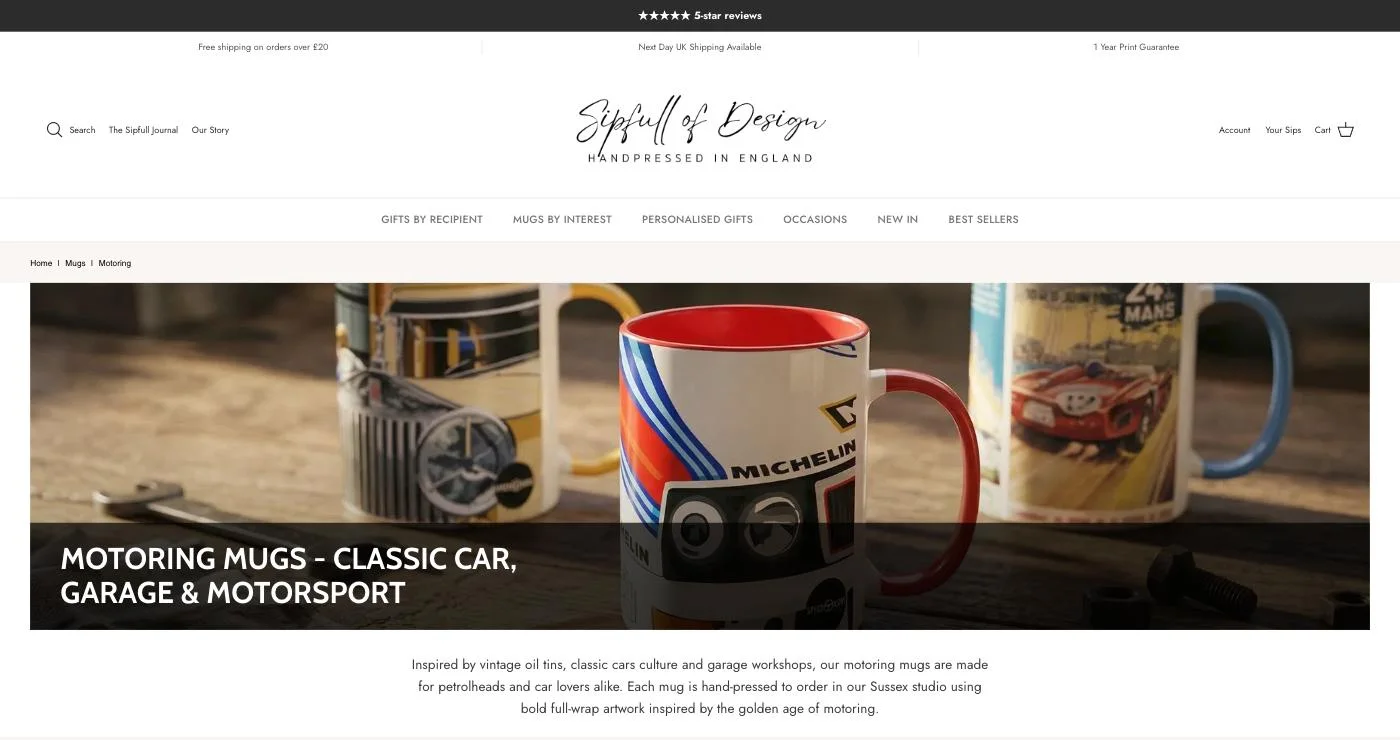
The menu and collections were reorganised by recipient, interest, occasion and personalisation instead of by product. That gave Google clear landing pages for real searches: gardening mugs, gifts for grandad, motoring mugs, dog mugs.
2. Structured data done in the theme
The page builder app was removed and product and merchant listing schema rebuilt directly in Liquid and metafields. One clean source of data instead of several competing ones.
3. Pages written to be quoted
Collection pages got clear introductions and FAQ sections that answer real questions in plain sentences. Key facts - handpressed to order in Sussex, prices, shipping - are stated the same way everywhere, so AI tools pick them up and repeat them accurately.
4. Google Merchant Center set up properly
Brand profile claimed, free shipping promotions added and product data cleaned up, feeding both free listings and Shopping campaigns.
5. Product pages tested, not guessed
Small layout changes were tested against add-to-cart rate. Moving the cross-sell block below the description on one product page lifted desktop add-to-cart from 4.7% to 7.8%.
6. Paid ads on top, not instead
Meta and Google Performance Max campaigns run alongside organic, with the product feed and site structure doing a lot of the work. Both have returned more than three times their spend in their strongest periods.
Where it ranks now
A selection of Google UK positions, September 2026
| Keyword and page | Position |
|---|---|
| gardening mugs with lids /collections/gardening | 1 |
| gardening mugs /collections/gardening | 2 |
| garden mug /collections/gardening | 3 |
| gardeners mug /collections/gardening | 3 |
| beer mug name /products/personalised-beer-mug | 3 |
| dog mom mug /collections/dogs | 4 |
| grandad travel mug /collections/gifts-for-grandad | 4 |
| car mugs /collections/motoring-mugs | 6 |
Source: Ubersuggest.
Over twice the Shopify average conversion rate
Traffic is only half the job. A standard theme rarely converts well, so we've spent a lot of time and money finding out what does and doesn't work on Sipfull.
What drives the conversion rate
A custom variant picker
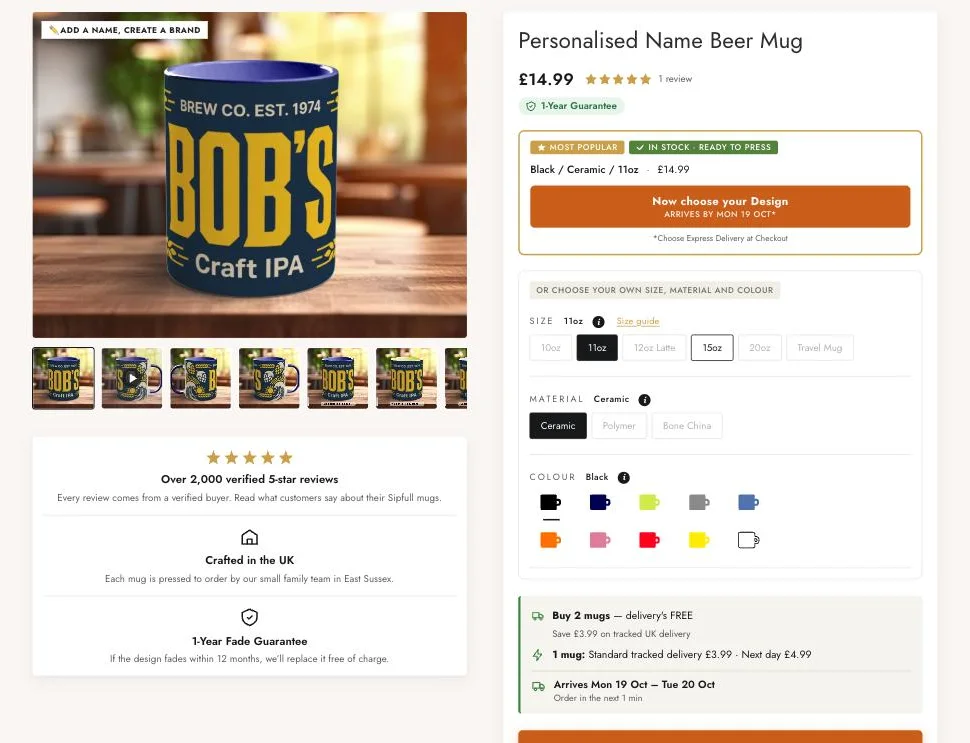
Personalised products have lots of options, and that's where shoppers give up. We built our own variant selector to make choosing size, style and personalisation simple, instead of relying on the theme default.
Collection pages that sell
Clear badges such as "Add Your Photos" and personalised products pinned where shoppers look first, so the most-wanted items aren't buried.
Product pages tested, not guessed
Add-to-cart rate is tracked by device and traffic source, and layout changes are tested against it. Moving one cross-sell block lifted desktop add-to-cart from 4.7% to 7.8%.
Keep what works, drop what doesn't
Not every change wins. The point is knowing which ones do - and that's the knowledge we bring to client stores.
Conversion rate
Share of visits that end in an order, last 12 months.
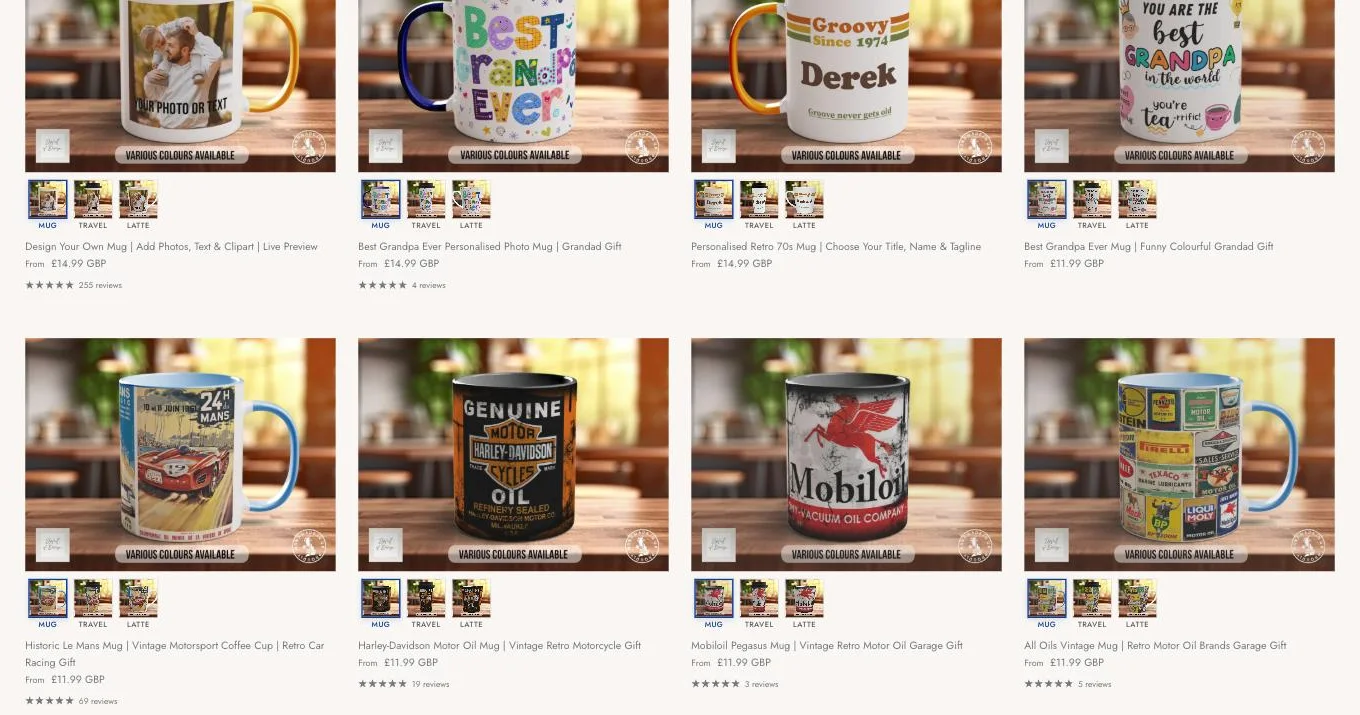
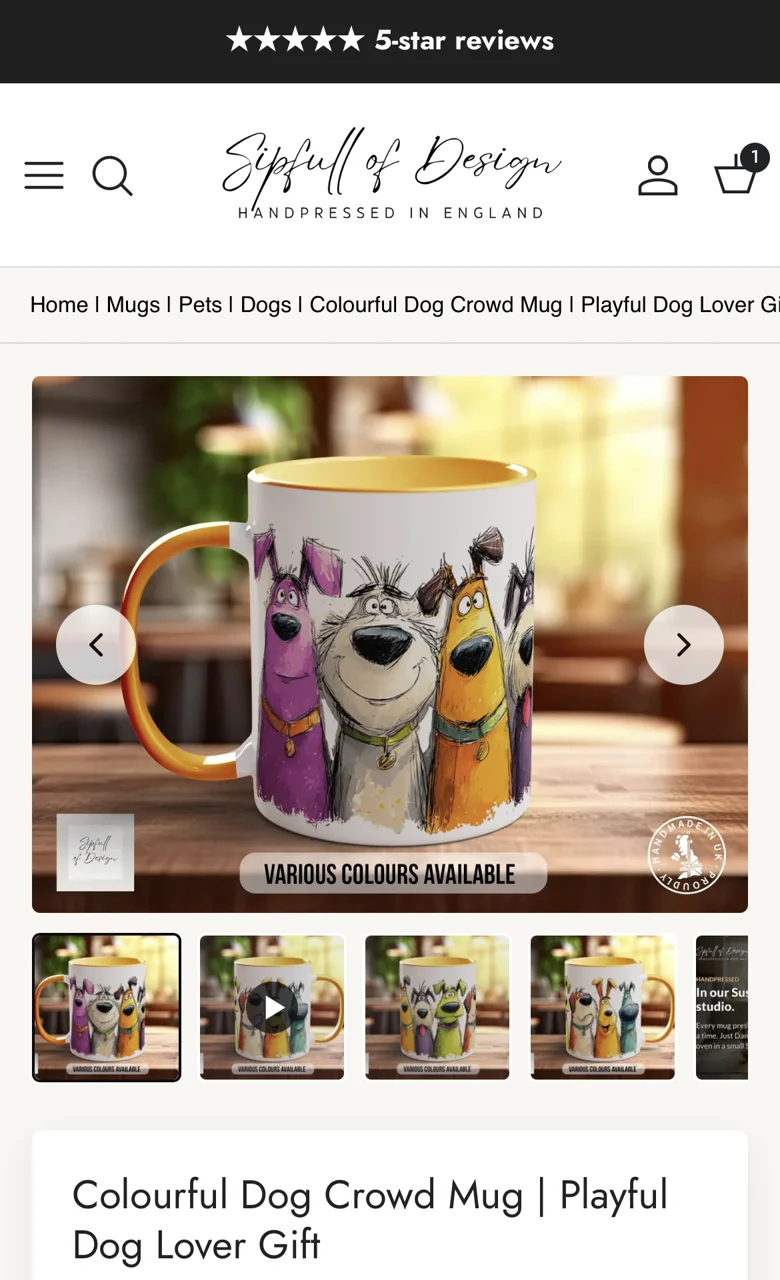
What converting looks like
Structure beats size
None of this came from buying links or outspending anyone. It came from how the site is built: pages that match real searches, clean structured data, and facts stated clearly enough for both Google and AI assistants to trust and repeat.
It's the same playbook we bring to every client, on Shopify or a bespoke platform: get the structure right, make the facts unmistakable, make it easy to buy, then measure what moves.
Want the same approach on your store?
Send us your URL and what you're trying to achieve. We'll come back to you with where we'd start.